The best chappal for men is a leather Peshawari chappal that matches your foot length, sits on a firm stitched sole and suits how you will wear it: a classic cross-strap pair for every day, a woven Norozi-style pair when you want it noticed, and a lighter handmade pair for long days on your feet. Measure your foot in centimetres before you pick a size, check the leather and the stitching, and give a new pair a few days to soften.
This guide explains what a Peshawari chappal is, how the classic, Norozi and Kaptaan styles differ, how to check real leather, how to size a pair with a worked example, and how to break it in and look after it. It is written for buyers in Pakistan.
What is a Peshawari chappal?
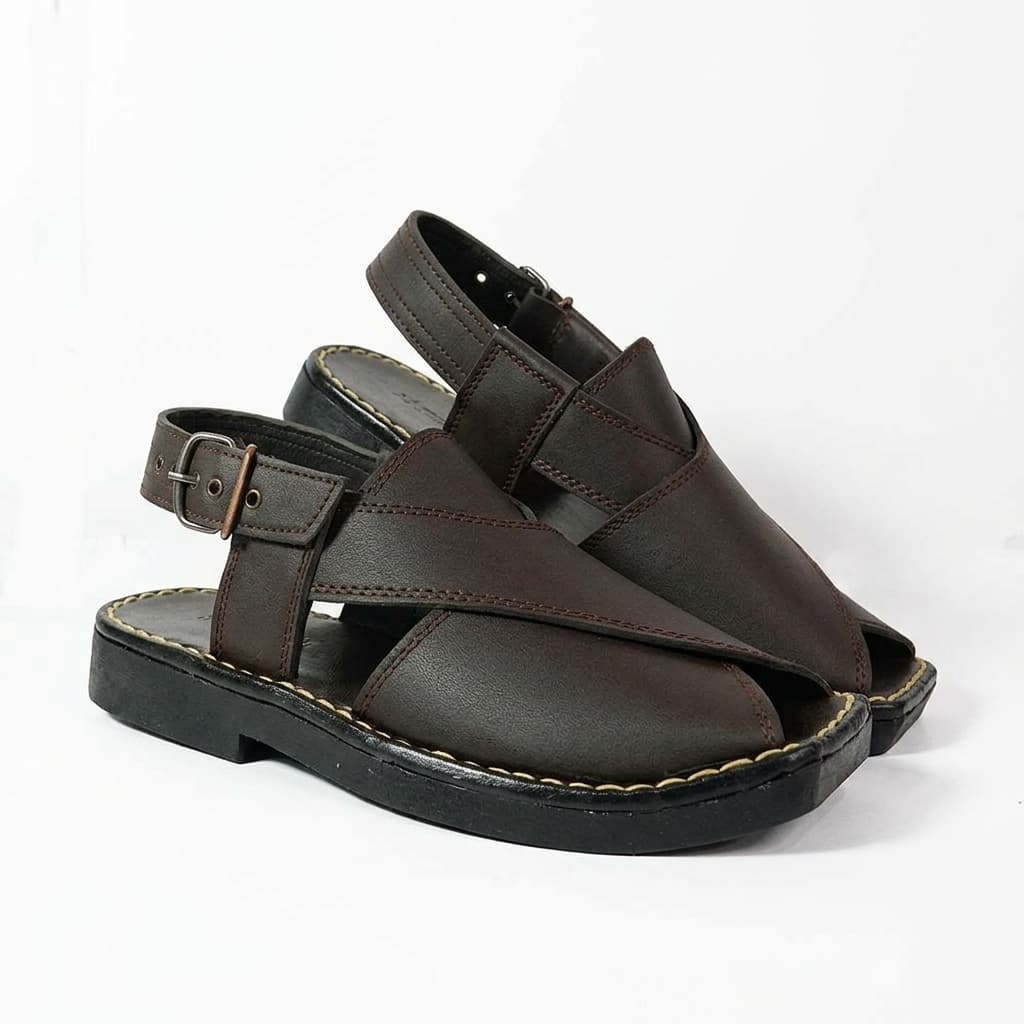
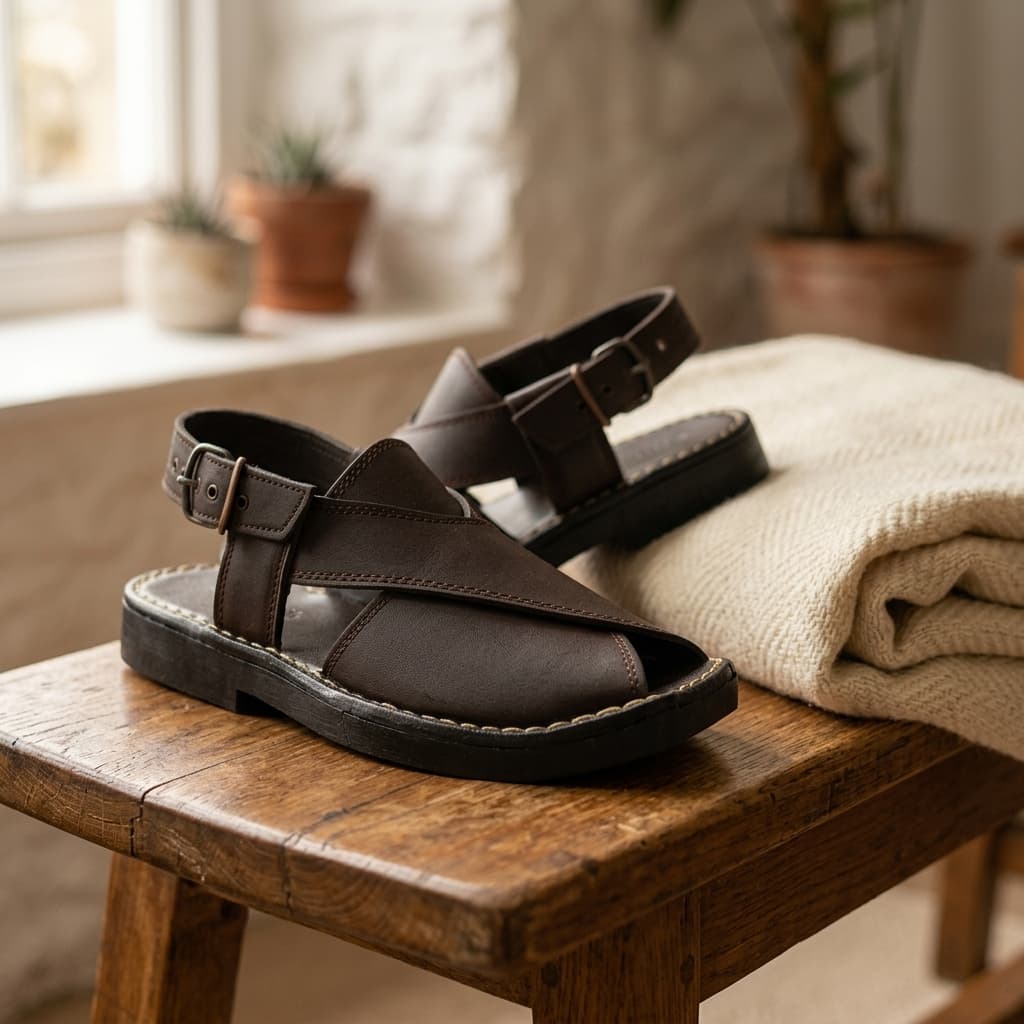
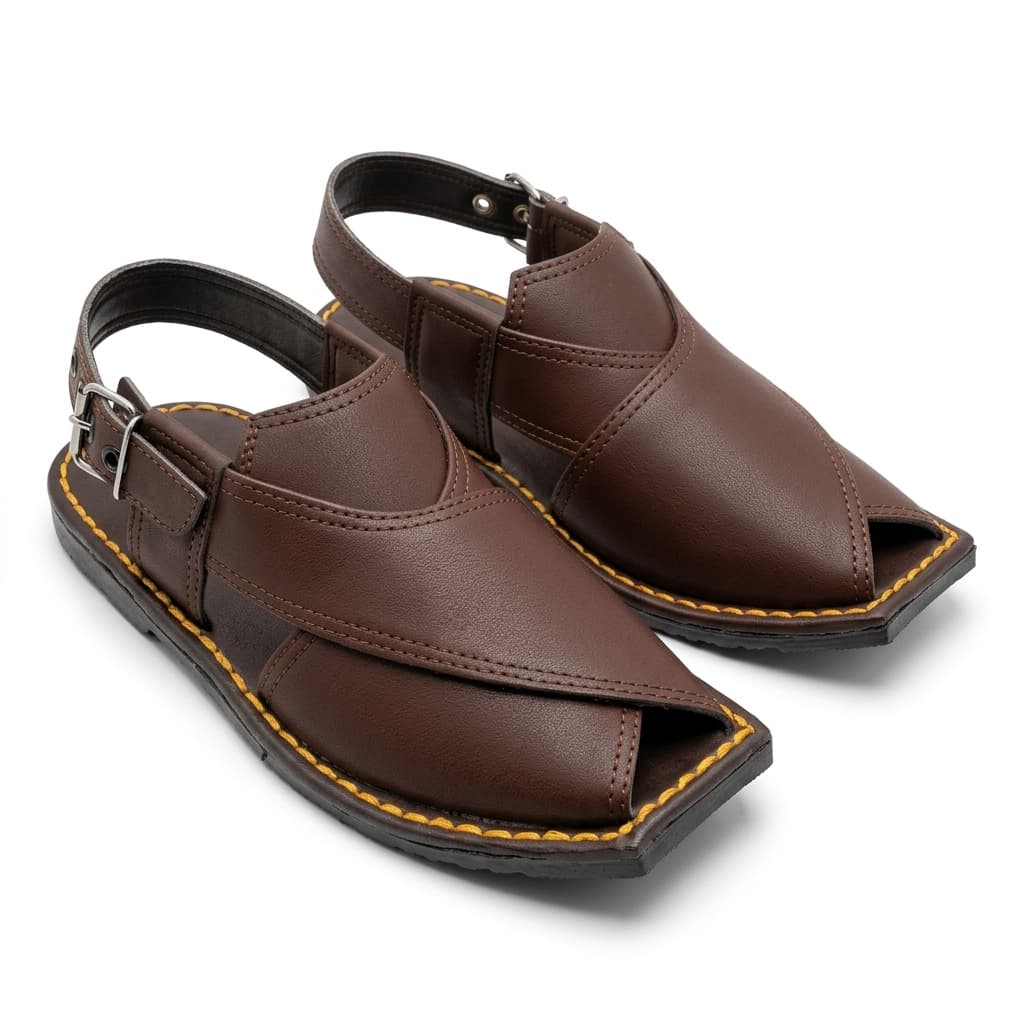
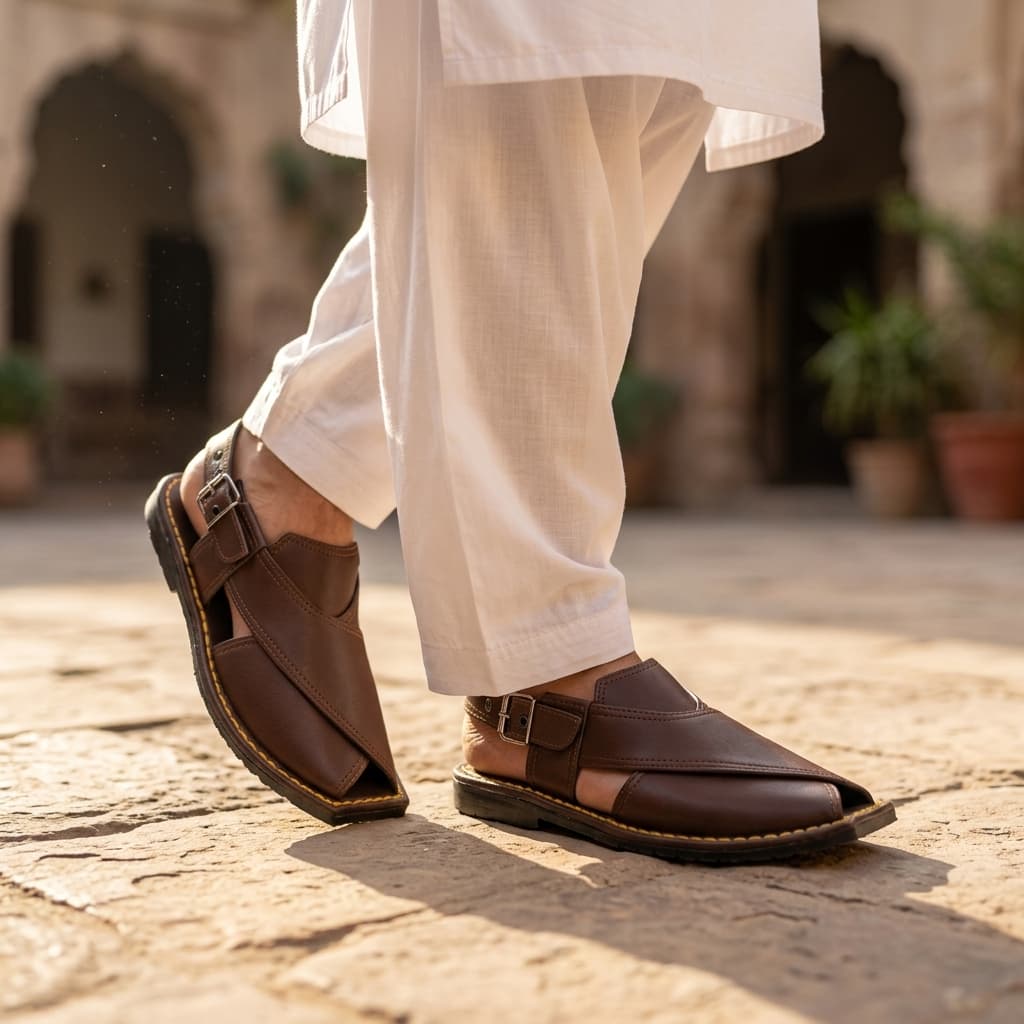
A Peshawari chappal is a flat, open leather sandal with a broad toe cover, wide straps crossed over the foot, a thick stitched sole and an adjustable back strap. Men wear it with shalwar kameez, kurta pajama and jeans, at work, at the mosque and at weddings.
The same sandal goes by other names. In Punjab it is often called a kheri, and the Wikipedia article on the kheri traces it to the hills of northern Punjab before Peshawar's workshops refined it with softer leathers. The upper is traditionally leather, and the sole is often cut from a truck tyre, sometimes with a leather sole sewn on top.
The design travels, too. In March 2014 the British designer Paul Smith sold a £300 sandal called the "Robert" that looked very like a Peshawari chappal. After a petition and a wave of complaints from Pakistan, the listing was changed to say it was "inspired by the Peshawari chappal" (Dawn, 11 March 2014).
What is the difference between Norozi and Kaptaan chappals?
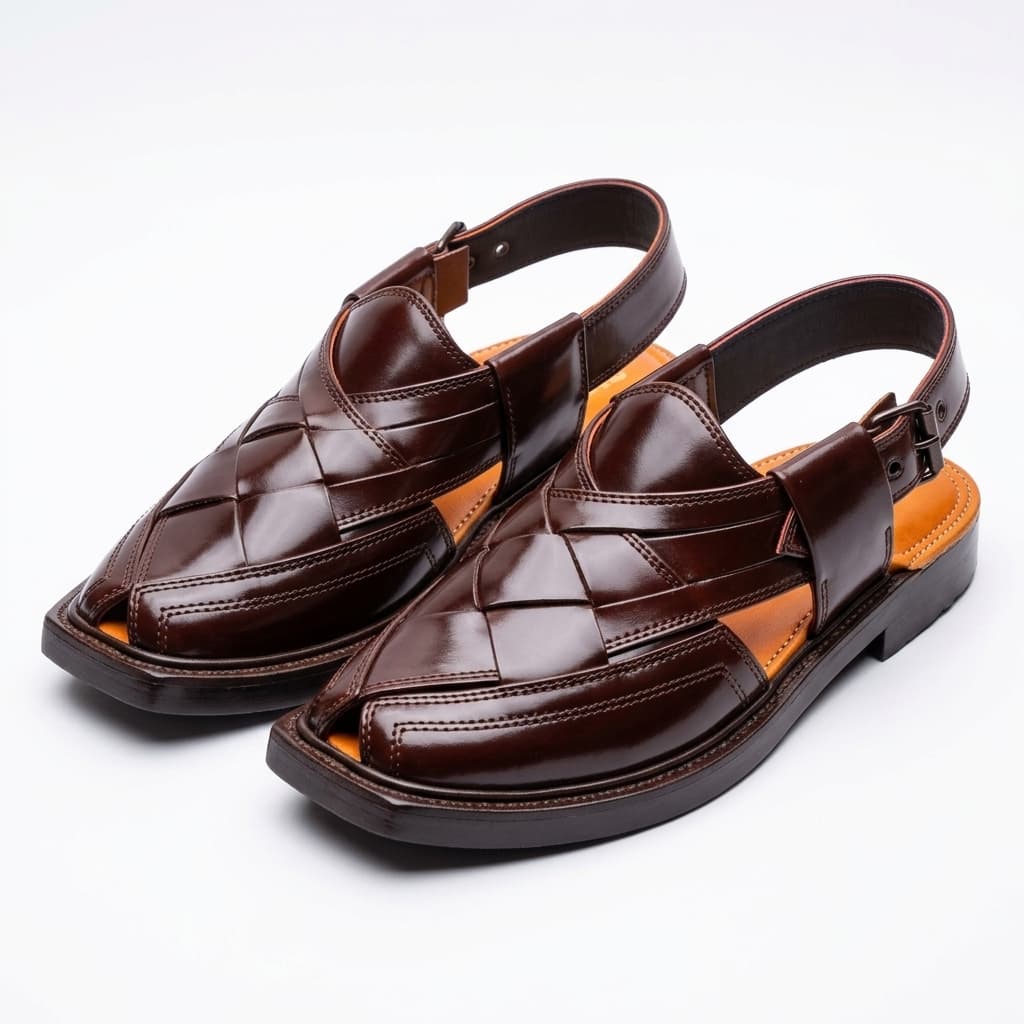
Norozi and Kaptaan are style names, not fixed standards, so two workshops can sell quite different pairs under the same name. Kaptaan points to the double-sole design a Peshawar cobbler made famous in 2014. Norozi has no single agreed definition; in our store it means a woven, braided leather upper. Judge a pair by its photos, its sole and its stitching, not by the label.
- Classic: a broad, layered toe cover with crossed straps over the foot. This is the pattern most people picture when they hear "Peshawari chappal".
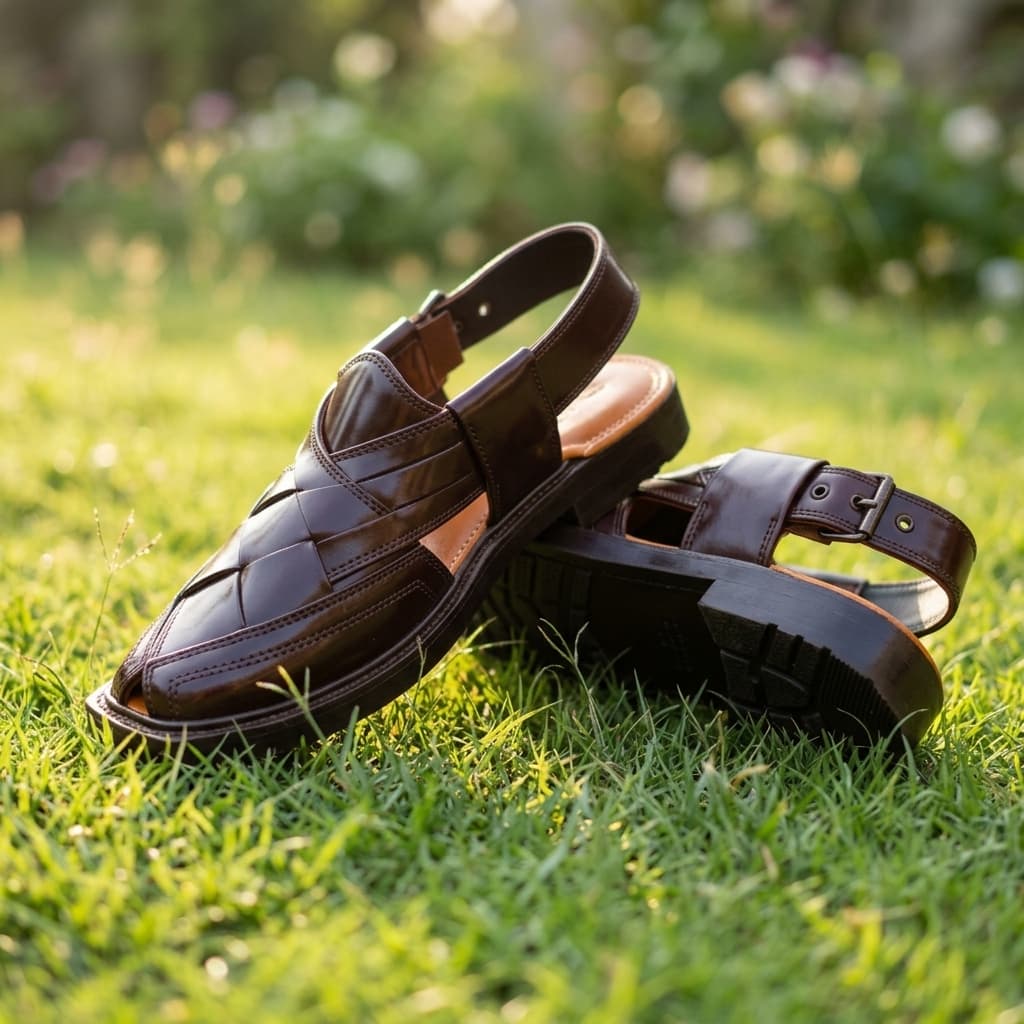
- Norozi style: strips of leather woven or braided across the front instead of a plain toe cover, which gives a textured, decorative look.
- Kaptaan: Arab News reports that the Peshawar cobbler Nooruddin, known as Chacha Noora, first made a pair for Imran Khan in November 2014, named it after Khan's cricket nickname, and describes it as a double-sole sandal. Many workshops now make their own Kaptaan versions.
| Classic | Norozi style | Kaptaan | |
|---|---|---|---|
| What the name points to | Layered toe cover, crossed straps | Woven or braided leather across the front | The double-sole design made famous in Peshawar in 2014 |
| Look | Plain and familiar | Textured and decorative | Varies from maker to maker |
| Good for | Every day, the office, the mosque, weddings | Eid, weddings, days you want it noticed | Check the sole and stitching of the pair you are shown |
| Cleaning | Wipe with a slightly damp cloth | Soft brush between the strips, then a gentle wipe | As for any leather pair |
| In our store | Hook-and-loop Peshawari chappal | Norozi-style Peshawari chappal | Not stocked |
If you cannot decide, a simple rule works: pick the classic if you will wear it every day, and the Norozi style if the pair is for Eid or a wedding.
How do I check if a chappal is real leather?
Real leather shows an uneven, natural grain, smells of leather rather than glue or plastic, and looks rough and fibrous at a cut edge. A synthetic can look the same from a metre away but fails these checks up close.
Run through them in a shop, or as soon as a parcel arrives:
- Look at the grain. Real leather has small variations across the surface. A perfectly repeating pattern points to a printed synthetic.
- Check the edges and the underside. A cut edge of real leather is fibrous. A plastic-coated material shows a smooth, rubbery layer.
- Smell it. Leather smells warm and natural. A sharp chemical smell suggests a synthetic or a heavy finish.
- Press with a fingertip. Real leather forms small wrinkles that relax. A synthetic stays smooth or stretches oddly.
- Look at the sole edge. The stitching should run evenly all the way round, with no gaps and no glue squeezed out between the layers. The sole is where a cheap pair fails first.
- Ask what the sole is made of. Tyre rubber, leather or a mix are all common; a seller should be able to tell you.
You will see the flame test recommended online. Don't use it on a pair you want to keep, and don't treat it as proof: finishes and coatings can fool it.
How do I choose the right chappal size?
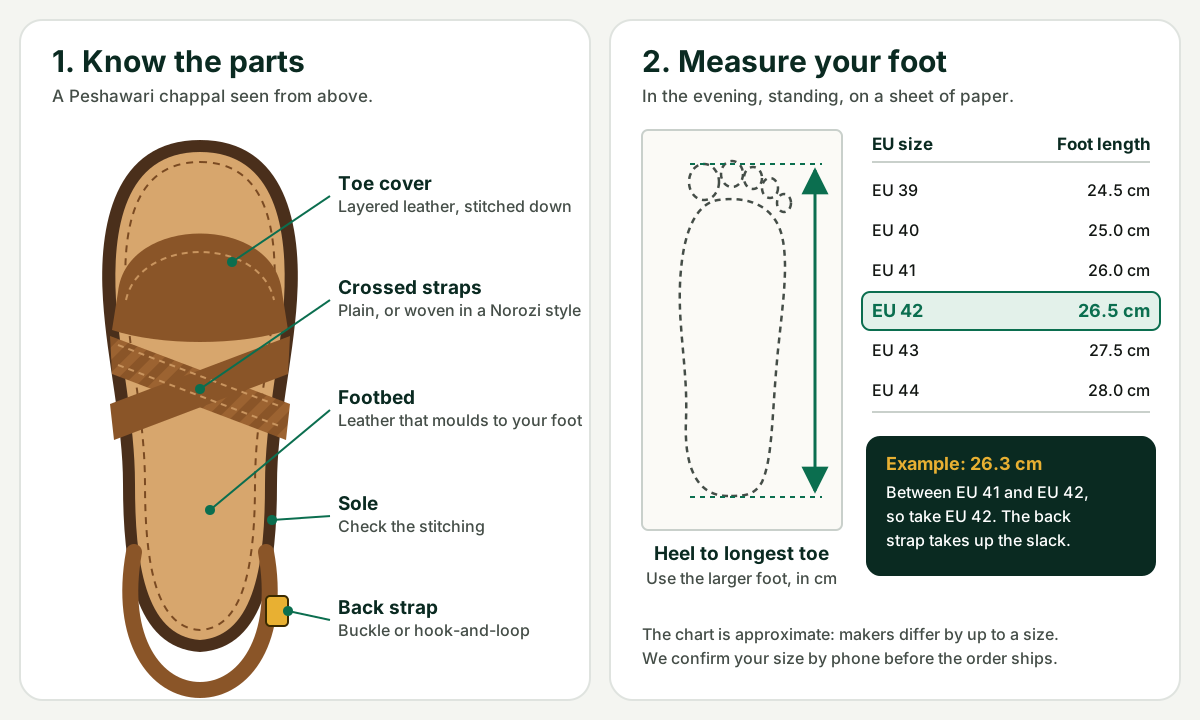
Measure your foot from the heel to the longest toe in centimetres, in the evening, and match it to the size chart for that chappal. If you land between two sizes, take the larger one: the back strap takes up a little slack and leather softens with wear.
- Stand on a sheet of paper, with your weight on the foot you are measuring.
- Mark the back of your heel and the tip of your longest toe, holding the pen upright.
- Measure the gap in centimetres. Do both feet and use the larger number.
- Find the nearest size in the chart below.
| Size | Foot length | UK |
|---|---|---|
| EU 39 | 24.5 cm | 6 |
| EU 40 | 25.0 cm | 6.5 |
| EU 41 | 26.0 cm | 7.5 |
| EU 42 | 26.5 cm | 8 |
| EU 43 | 27.5 cm | 9 |
| EU 44 | 28.0 cm | 9.5 to 10 |
This is the men's footwear chart on our product pages. It is approximate, and makers differ by up to a size, so we confirm your size by phone before an order ships.
Worked example: a 26.3 cm foot
Say your right foot measures 26.1 cm and your left 26.3 cm. Use 26.3 cm, the larger foot. That sits between EU 41 (26.0 cm) and EU 42 (26.5 cm), so choose EU 42, which is UK 8. When we call to confirm the order, tell us "26.3 cm" as well as "42", so the size can be checked against the pair itself.
| If this is you | Choose |
|---|---|
| Between two sizes | The larger one |
| Wide or high-arched foot | The larger one |
| You plan to wear thin socks in winter | The larger one |
| Narrow foot, exactly on a size | Your measured size; tighten the back strap |
How it should fit: your heel rests on the footbed with the back strap behind it, your toes stay on the footbed without reaching over the front edge, and the straps feel snug across the foot without pinching.
How do I break in a new Peshawari chappal?
Break a new pair in gradually: wear it indoors for an hour or two at a time over a few days, bend the sole by hand, and keep it away from water. Most of the stiffness is the leather and the sole taking the shape of your foot.
- Try it on indoors on a clean floor first. If the size is wrong, stop there: you can send an unused pair back within 7 days of delivery (how returns work).
- Flex the sole at the ball of the foot a few times before each wear.
- Don't soak it to stretch it. Water stiffens and can warp leather as it dries.
- Treat one rubbing spot with a little leather conditioner. If the rubbing carries on, the pair is too small, and it will not fix itself.
- A woven Norozi upper usually settles within a day or two, as the strips give slightly across the foot.
How do I look after a leather chappal?
Keep it dry, wipe off dust after wearing, and let it rest between wears. Leather lasts longest away from sun, heaters and damp.
- Wipe it with a dry or slightly damp cloth after use. Brush dust from between the strips of a woven pair with a soft brush.
- If it gets wet, let it dry slowly in the shade at room temperature, not on a heater or in direct sun.
- Rub in a little leather conditioner when the leather looks dry or pale.
- Store it flat in a dry place, and rotate two pairs if you wear a chappal every day.
- Take it to a local cobbler before the sole wears through to the footbed. A resole often costs less than a new pair.
Which chappal suits which occasion?
Match the pair to the day: a dark classic or a Norozi style for Eid and weddings, a classic you can slip on and off for work and the mosque, and a light pair for long days on your feet.
| Occasion | Sensible pick | Tip |
|---|---|---|
| Eid or a wedding | Norozi style in maroon or black, or a classic in black or dark brown | Wipe and condition it the week before |
| Office, mosque, daily wear | Classic with a hook-and-loop back strap | Quick on and off; rotate two pairs |
| Long days on your feet, travel | Lightweight handmade pair | Break it in before a trip, never on one |
| Winter | Any style, sized for thin socks | Keep it dry |
Shopping for the women in the family for Eid as well? Our khussa are made for women and girls. For cold evenings, a pashmina shawl goes with a leather chappal and a shalwar kameez.
Our three Peshawari chappals
We sell three Peshawari chappals in the Pakistan store, all for men, all in EU 39 to 44, and all cash on delivery. We call or message you to confirm the size, colour and delivery date before anything ships, and delivery usually takes 3 to 5 business days (shipping details).
| Chappal | Style | Closure | Colours listed |
|---|---|---|---|
| Hook-and-loop Peshawari chappal | Classic, layered leather toe cover | Hook-and-loop back strap | Black, tan, dark brown, blue |
| Norozi-style Peshawari chappal | Woven, braided leather upper | Adjustable back strap | Red-brown, black, brown, maroon |
| Lightweight handmade Peshawari chappal | Handmade, lighter build for casual wear | Adjustable back strap | Dark brown, tan, black |
Our product photos are AI-generated illustrations of each design, so colour and small details can differ from the pair you receive. That is one more reason we call first: ask us about the leather, the sole or the colour on that call, before you pay anything. You can compare all three on our Peshawari chappals page.
Checklist before you order
- Measured both feet in the evening, in centimetres, and used the larger one
- Picked the size from the chart, taking the larger one if between sizes
- Chosen the style for how you will wear it: classic, Norozi style or lightweight
- Checked the leather, the sole edge and the stitching, in the shop or on arrival
- Planned a few days of indoor wear before the first long day out
- Know the returns window: 7 days from delivery, unused